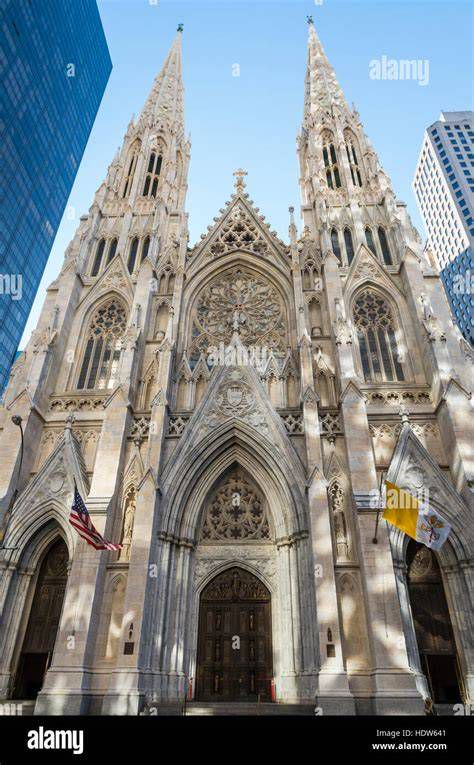
St. Patrick's Cathedral on Fifth Avenue is one of the most recognizable and beloved works of nineteenth-century American architecture. For many Irish New Yorkers, it is a vivid symbol of their presence, accomplishments, and history in and around New York City. The cathedral occupies a city block bounded by Fifth Avenue, Madison Avenue, 50th Street, and 51st Street, directly across from Rockefeller Center.
Origins, site and early Catholic New York
The Diocese of New York was founded by Pope Pius VII in 1808. St. Patrick's was founded shortly afterward to serve New York City's small, but growing, Catholic population, which could no longer fit in St. Peter's Church. A site was selected on Mulberry Street in what is now Lower Manhattan for the earlier parish, and the land for the present-day St. Patrick's Cathedral was acquired by the Catholic Church through a myriad of real estate transactions in the early nineteenth century. The lot on Fifth Avenue was first acquired from the City by a Robert Lylburn for $405 in 1799 and, through a series of transactions, was acquired in 1852 for $5,550 by Francis Cooper, a trustee of St. Patrick's Cathedral.
In less than a century after the American Revolution, the Roman Catholic religion made huge strides in both population and presence in the United States and especially in predominately Protestant New York. Faced with religious as well as ethnic discrimination, the early Catholics in New York were not widely accepted; by the early 1840s the number of Catholics in the Diocese of New York had increased to 200,000. With the apparent need for Catholics in New York to have their own diocese and cathedral, planning for a new, larger cathedral in what was then the city's "countryside" (midtown Manhattan) began under Archbishop John Hughes in the early 1850s.
James Renwick Jr. and the gothic revival design
St. Patrick’s Cathedral was designed by James Renwick Jr. in the Gothic Revival style. Renwick was an American architect born in New York City in 1818 to a well-educated and wealthy family. Renwick studied engineering at Columbia and graduated in 1836 at the age of eighteen. He did not, however, formally study architecture. Renwick received his first major commission at the age of twenty-five, when he was chosen to design Grace Church in New York City in 1843. Other commissions that Renwick had executed prior to his work on St. Patrick's included Vassar College's Main Hall (known as "The Castle"), the New York Public Library, the original facade for the New York Stock Exchange, plus many banks, hospitals, and several mansions for the wealthy of New York.
Renwick collaborated with fellow architect William Rodrigue and began developing the idea of a grand cathedral with Archbishop Hughes in 1853. Renwick spent three years in Europe to look for design influences for New York City's new Catholic cathedral and took particular inspiration from the unfinished Cologne Cathedral. In choosing an architectural style for the new cathedral, Renwick looked towards the period in European architecture known as the "high gothic." Influences of French high gothic on St. Patrick's include the cruciform plan of the Cathedral and the twin spires that would be later added to the original construction to complete the building.
Construction timeline and major phases
Plans for the cathedral were finalized in 1858, and the first construction contracts for the new Fifth Avenue cathedral were issued in June 1858. On August 15, 1858, the cornerstone was laid in a ceremony organized by Archbishop Hughes, with a procession and an estimated crowd of approximately one hundred thousand spectators. The initial estimate for construction was $850,000; one hundred and three subscribers donated $1,000 apiece to the building fund, and two subscribers were non-Catholics.
Construction began in 1858 but was halted in 1860 when available funds were exhausted; after two years the perimeter walls had risen to a height of sixteen feet and then stopped. The outset of the American Civil War in 1861 prevented the resumption of major work for several years. Archbishop Hughes died in 1864 and never saw the cathedral completed. Work recommenced in 1865 and by mid-1866 the walls had been built to 20 feet above ground. By late 1870 the marble walls had been built to a height of 54 feet and the transept was finished. The new St. Patrick's Cathedral opened on May 25, 1879; the first mass was held that day with Cardinal McCloskey presiding and roughly seven thousand people in attendance.
Although the cathedral was opened in 1879, several additions and renovations followed. From 1882 to 1884 the archbishop's house and rectory were added to the site, both designed by James Renwick Jr. The spires were added in 1888 after funds became available; George Mann & Company of Baltimore was awarded the construction contract. The Lady Chapel, designed by Charles T. Mathews and paid for by the Kelly family, was constructed from 1901 to 1906. The cathedral was consecrated on October 5, 1910, after all its debt had been paid off, as required by church policy.
Architectural features and materials
St. Patrick's Cathedral is clad in white marble and has several dozen stained glass windows. The white marble was chosen even though it was the most expensive option. The cathedral measures 332 feet (101 m) long, with a maximum width of 174 feet (53 m) at the transepts. The bronze doors that form the cathedral's main entrance on Fifth Avenue are flanked by towers with spires rising 329.5 feet (100 m). The northern tower contains nineteen bells, and the interior has two pipe organs.
The cathedral features a cruciform layout with a long central nave, side aisles, transepts, a chancel and apse, and a crypt. The cruciform plan and the inclusion of flying buttresses, pointed arches and vaulting reflect the high Gothic influences. The flying buttress system allowed for clerestory windows and greater interior light, and interior columns were made smaller as lateral wind forces were directed to perimeter exterior buttresses. The lines of a Latin cross form the plan of Saint Patrick's; the lines of the church compose the long arm of the cross.
Interior art, chapels and notable works
Inside is a nave flanked by several chapels; two transepts; and a chancel and apse. The cathedral is home to famous works by admired artists, including the great rose window, one of Charles Connick’s most notable pieces. World-renowned designers contributed as well; Tiffany & Co. designed the St. Michael and St. Louis altar and Pablo Medici of Rome designed the St. Elizabeth altar. The Lady Chapel was originally outfitted with transparent windows though its stained-glass windows were manufactured in Europe starting in 1909.
One of the most notable sculptural features is a pietà in marble that is three times the size of Michelangelo’s at St. Peter’s Basilica in Vatican City. The cathedral also contains a memorial marble pulpit manufactured in Italy and installed in 1885. Over time the cathedral received new altars, bronze screens, an upgraded marble floor, new organs, and a variety of decorative and liturgical furnishings that harmonized with Renwick’s Gothic design.
Construction challenges, fundraising and community role
The construction of St. Patrick's was a monumental social undertaking as well as an architectural one. Responding to criticism that the cathedral was an extravagance while poverty and need existed throughout New York City, Archbishop Hughes stated that the cathedral project provided employment opportunities for hundreds of workers and that he would personally see to it that all wages would be paid. The trustees borrowed funds from banks and organized large fairs to raise money; Cardinal McCloskey later organized a particularly fruitful fundraising fair.
Most funding for the cathedral came from parishioners of the archdiocese, who were mainly poor Irish immigrants. For many Irish New Yorkers, St. Patrick's is a vivid symbol of their presence and achievements. The cathedral also became a focal point of St. Patrick’s Day celebrations: the inaugural St. Patrick’s Day parade in New York City took place in 1762 and the parade passes by the steps of New York’s St. Patrick’s Cathedral, reinforcing the cathedral’s cultural role.
Renovations and twentieth-century updates
The cathedral went through several renovations over the following decades after its opening. In the 1920s Monsignor Michael J. Lavelle raised funds to renovate the cathedral, and Robert J. Reiley was hired to conduct renovations, including replacing the wooden floor with a marble floor between April and December 1927. The old organ was replaced and new stained-glass windows, altar, and pews were installed in the Lady Chapel. The rectory saw its first major renovation in 1940.
Archbishop Francis Spellman announced in 1941 that an anonymous donor had provided funding for a new high altar to replace an altar that had been "architecturally inconsistent" with the cathedral's design. Over the decades the cathedral has seen maintenance, art conservation, and upgrades consistent with preserving Renwick's vision while accommodating liturgical and structural needs.
Dimensions, capacity and presence
The cathedral can hold up to 2,200 people. It measures 332 feet long with a maximum width of 174 feet at the transepts; the twin spires rise roughly 330 feet. East of the apse are the rectory, Lady Chapel, and archbishop's residence facing Madison Avenue. The cathedral's parish originally extended across a wide section of midtown Manhattan, reflecting its central ecclesiastical role.
Quick facts (summary table)
- Architect: James Renwick Jr. (primary), with William Rodrigue and later Charles T. Mathews (Lady Chapel)
- Style: Gothic Revival / Neo-Gothic
- Construction started: 1858 (cornerstone August 15, 1858)
- Major halt: 1860-1865 (funds, Civil War)
- Opened: May 25, 1879
- Spire completion: 1888
- Lady Chapel: 1901-1906
- Consecrated: October 5, 1910 (after debts paid)
- Material: White marble cladding
- Length/width: 332 ft / 174 ft
- Spires height: ~329.5 ft
- Capacity: ~2,200
7 Facts About St. Patrick's Cathedral New York City
Legacy and cultural significance
Prior to the design and construction of St. Patrick's Cathedral, no Gothic cathedral of such size and prominence had been constructed in America. Renwick not only succeeded in bringing the Gothic style to cathedral design in the United States, he also set a precedent for future cathedrals. The new St. Patrick's was met with generally positive reception; the Baltimore Sun called it the "finest church edifice on the American continent," though some critics disparaged certain aesthetic choices.
St. Patrick's Cathedral remains a focal point of Catholic life in New York as the seat of the Archbishop of New York as well as a parish church. It symbolizes Irish-American pride and serves as a cultural and spiritual landmark in the heart of Manhattan, welcoming millions of visitors, worshippers, and pilgrims each year.