The term “cult” evokes strong feelings in contemporary discourse, often conjuring images of secretive groups led by charismatic and manipulative leaders. However, its meaning and the distinction between cults and mainstream religions is complex and has changed significantly over time. Exploring these differences requires an understanding of both historical context and modern usage.
Origins and Historical Definition of "Cult"
Historically, the term “cult” was not pejorative. It simply referred to smaller religious groups or a particular form or system of religious worship or veneration, as expressed in ceremonies or rituals directed towards a specified figure or object. In Ancient Rome, cults were deeply integrated into society, such as the imperial cult worshiping deceased emperors, and temples dedicated to gods were both religious and lucrative centers. The cult of Isis in Pompeii, for example, demonstrates how mystery cults and elite initiation rituals could intersect with civic structures.

In academic works on Classical history, “cult” denotes a set of religious devotional practices related to a figure or place, often conventional within its culture. Far from being opposed to societal norms, many Roman cults reinforced civic and political order.
Evolving Connotations and Modern Definitions
Modern society has drastically altered the meaning of “cult.” The word now refers to religious groups outside of the mainstream, often associated with dangerous or illegal activities and worship of a charismatic, brainwashing leader. In popular usage, cult is applied to new religious movements and groups perceived as strange or sinister, exercising excessive control over members.
- The Oxford English Dictionary defines cult as “a system of religious worship and devotion directed towards a particular figure or object.”
- The Oxford English Dictionary (usage in 1875) describes cult as: “A relatively small group of people having (esp. religious) beliefs or practices regarded by others as strange or sinister, or as exercising excessive control over members.”
Many new religions are controversially labeled as cults, and the term has been criticized for lacking scholarly rigor and being used pejoratively to cast aspersions on a group’s legitimacy.
Key Differences Between Cults and Religions
Religions and cults share similarities such as systems, devotion, and worship, but differ fundamentally in several ways. While mainstream religions have leaders (popes, priests, rabbis, etc.), these leaders, for the most part, do not abuse, manipulate, or control their followers. Cult leaders are often at the epicenter of the group, exercising total control, and projecting themselves as divine or uniquely enlightened beings. Cults generally stand in tension with dominant religious or cultural inclinations of society and are more restrictive, authoritarian, and isolating.
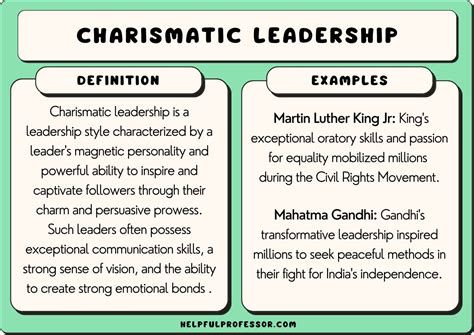
Members of mainstream religions can live normal lives; cult members may experience isolation, threats, or punishment for dissent. Cults often use indoctrination methods such as hypnosis, repetition, and behavior modification techniques to control beliefs and behaviors.
Impact on Members and Society
Cults have been known to prey on the weak, young, and naive, and may disconnect followers from family and everyday life. Many children are born or indoctrinated into cults, continuing cycles of control. Notably, cult leaders have convinced masses to commit suicide or reject mainstream life, as in the People’s Temple tragedy led by Jim Jones, where 918 people died.
- Being a member of a mainstream religion is compatible with societal integration.
- For cult members, the group and leader often become the center of their lives.
- Money donated to religious charities is less likely to benefit founders directly compared to cults.
One of the Most Disturbing Cults in Modern History…and it Still Exists
Cults are usually small groups devoted to a person, idea, or philosophy, often manipulating followers into total commitment and loyalty.
Academic Perspectives and Typologies
Beginning in the 1930s, new religious movements became the focus of sociological study. Scholars such as Max Weber distinguished between church, sect, and cult. The Bainbridge-Stark typology identifies:
- Cult movements: Complete organizations, not splinters from bigger religions.
- Client cults: Offer services such as psychic readings or meditation sessions.
- Audience cults: Loosely organized, propagated through media.
Some scholars argue all religious sects originated as cults. Over time, some cults became culturally accepted, tension resolved, and were recognized as sects or churches. For example, Seventh-day Adventists and the Church of Jesus Christ of Latter-day Saints progressed from cult status to mainstream recognition.
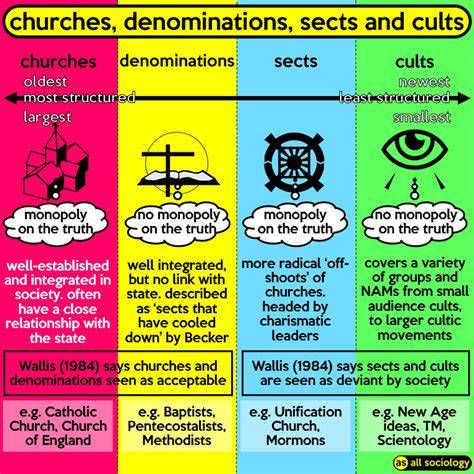
Researchers debate the term “destructive cult,” noting it may not always apply to groups, many of which are benign or positively impact society.
Societal and Political Responses to Cults
From the 1960s, anti-cult movements emerged in response to new religions and events such as Jonestown. The notion that cult members were brainwashed justified forcible deprogramming, involving kidnapping and coercive techniques. This led to legal battles, psychological research, and a broader skepticism about the validity of brainwashing theories.
- In the mass media, cult became associated with psychological abuse, sexual abuse, criminal activity, and mass suicide.
- Studies in the 1980s and 1990s concluded that brainwashing accusations lacked factual basis.
Governments in various countries, such as China and Russia, have categorized certain religions as “evil cults” or suppressed groups not authorized by the state, leading to punishment and exclusion.

"New Religious Movement" as Preferred Term
Given the negative associations of the term cult, many sociologists prefer “new religious movement” (NRM) to describe groups previously called cults, dissociating them from implied illegitimacy. In contemporary academia and secular media, definitions continue to diverge, with some focusing on manipulation and authoritarian practices, and others on doctrinal deviation, particularly in evangelical Christian circles.
- NRMs may be manipulative, demanding total commitment and loyalty.
- Some are accused of distorting fundamental doctrines, leading scholars to reject their legitimacy.
Cult and Religion: A Fluid Boundary
Ultimately, all religions begin as cults. Christianity, for example, was once the cult of Jesus, becoming a religion only after mainstream acceptance and the founder’s death. The dividing line may be as simple as this: a religion is a cult that has become successful, mainstream, and socially acceptable.
| Feature | Religion | Cult |
|---|---|---|
| Size | Millions of followers | Usually small groups |
| Leadership | Structured, multiple leaders | Charismatic, single leader |
| Integration | Compatible with society | Isolation from society |
| Societal perception | Legitimate, mainstream | Controversial, pejorative |
| Control | Low to moderate | High, authoritarian |
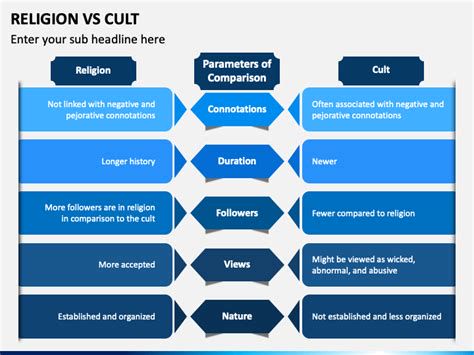
Despite overlapping definitions-devotion, worship, ceremonies-the core differences lie in leadership style, integration with society, member autonomy, and societal legitimacy. As definitions and perceptions continue to shift, understanding these nuances is crucial to distinguishing cults from mainstream religious groups.