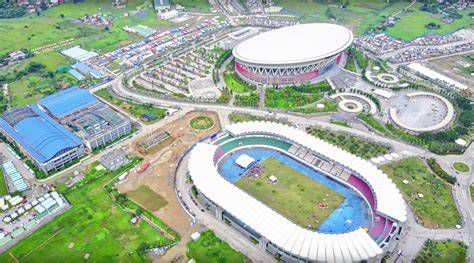
The Philippine Arena is a landmark project of the Iglesia Ni Cristo (INC) located at Ciudad de Victoria in Bocaue, Bulacan. It stands as the crown of a huge complex where a hospital, school, sports stadium (Philippine Stadium) and sports center (Philippine Sports Center) are also being built. INC says this huge structure is one of the highlights of Ciudad de Victoria, a massive 75-hectare complex constructed by the group in Bulacan.
Design, dimensions and capacity
The Philippine Arena alone was built on a total lot area of 74,000 square meters, and has a total floor area of 99,000 square meters. The Philippine Arena will have a seating capacity of 50,000 to 55,000 with a floor area of 74,000 square meters and a domed roof which is nearly 36,000 square meters. The group says the arena’s roof will contain 9,000 tons of steel and will span 520 feet. The Arena itself costs $212 million or P9 billion.
Architects, engineers and construction timeline
A company in Australia, Populous, designed the architecture of the Philippine Arena. Populous said that “[t]he building’s capacity is its challenge.” Hanwha E&C vice president Kwon Ho Ha revealed in the Discovery Channel documentary that the time given for the construction of the arena was only 24 months originally, making it one of the world’s fastest construction timelines.
In the documentary, James also explained how they studied crowd mobility in the arena.
The construction, however, was not without mishap. In July 2013, two Filipino workers died, while another was critically injured.
Function, features and comparisons
The Philippine Arena is under the category of "mixed use indoor theater or arena" and the largest in this category. The Philippine Arena is a fully air-conditioned indoor domed structure. The National Stadium and Mercedes-Benz Superdome also have retractable roof and expandable, while Philippine Arena is a fully air-conditioned indoor domed structure. The arena is a one-sided bowl, designed to host major events and performances.
Uses
- It will be used for church gatherings but can also be used by public in general like local and international concerts, etc.
- The Iglesia Ni Cristo week-long Centennial Celebration was held at the Ciudad de Victoria complex that started with the inauguration of the Philippine Arena last July 21, 2014.
Centennial events and major gatherings
On July 27, 2014, the 100th anniversary of the Iglesia Ni Cristo, a special thanksgiving worship service officiated by Brother Eduardo V. Manalo, INC Executive Minister, was held at the Philippine Arena attended by more than 1.5 million INC members. This event was followed by INC Centennial Oratorio. On July 29, 2014 a special musical play was featured. On July 31, 2014, a stage play was featured.
During the centennial inauguration on July 21, 2014, the Philippine President, Benigno S. Aquino, attended events at Ciudad de Victoria. The said Arena is located at Ciudad de Victoria in Bocaue, Bulacan. The Iglesia Ni Cristo week-long Centennial Celebration was held at the Ciudad de Victoria complex that started with the inauguration of the Philippine Arena last July 21, 2014.
Context within Iglesia Ni Cristo history and global expansion
The Iglesia Ni Cristo was preached by Brother Felix Y. Manalo, God’s Messenger in these last days, and was registered in the Philippines on July 27, 1914. From its first local congregation in Punta, Sta. Ana, Manila, the Church quickly spread not only throughout the metropolis but also to the neighboring provinces in Luzon and across the islands of Visayas and Mindanao. When Brother Felix Manalo passed away on April 12, 1963, the Church had already established ecclesiastical districts in more than half of all the provinces in the country.
In 1968, the Church, led by Brother Eraño G. Manalo, the Executive Minister then, successively established the first two local congregations outside the Philippines-Honolulu, Hawaii and San Francisco, California in the USA. Thus began the Church’s expansion in the Far West and eventually around the world. From then up to the end of the ‘70s, the Church went on to spread throughout the continents of North America, Europe, Australia, Asia and Africa. By the end of the ‘80s, there were local congregations and group worship services in the Scandinavian countries and their neighbors. The first local congregation in Latin America was established in Guantanamo Bay, Cuba in 1990.
Iglesia ni Cristo (INC) is an international Christian religious movement that constitutes the largest indigenous Christian church in the Philippines. It teaches the doctrine of the Last Judgment and upholds a strict biblical prohibition on consuming the blood of animals. Services are held in the vernacular language of the congregation’s members. The church publishes a journal, Pasugo (“God’s Message”), in Tagalog, English, and other languages. Its headquarters are in Quezon City, Philippines.
Ciudad de Victoria masterplan and future projects
There will be more construction in Ciudad de Victoria in the following years like the planned EGM Medical Center, just among many. It is the crown of a huge complex where a hospital, school, sports stadium (Philippine Stadium) and sports center (Philippine Sports Center) are also being built.
Accessibility
The complex is served by major roads including the Luzon Expressway (NLEx), facilitating access from Metro Manila and other provinces. The arena and surrounding developments aim to foster culture and arts, sports, and eco-tourism.
Recognition and other projects
Other construction projects in the country that were recognized that year include SM Aura Premier (best retail project - medium cap project) and the Trump Tower (best residential project - medium cap project). The Philippine Arena’s groundbreaking and fast construction schedule drew wide attention in architecture and engineering circles.
Interesting facts and distinguishing points
- The Philippine Arena is the largest mixed use indoor theater or arena in its category.
- Its roof uses thousands of tons of steel and spans hundreds of feet to create a vast enclosed, air-conditioned space.
- The arena hosted the Iglesia Ni Cristo centennial events, with programs that included huge choirs, musical plays and massive worship services.
- Populous, the Australian-based design firm, emphasized that the building’s capacity was its main design challenge.
Table: Key specifications at a glance
- Lot area: 74,000 square meters
- Total floor area: 99,000 square meters
- Roof span: 520 feet
- Steel in roof: 9,000 tons
- Seating capacity: 50,000-55,000
- Approximate cost: $212 million (P9 billion)
- Construction timeline target: 24 months
The Philippine Arena remains a defining structure for the Iglesia Ni Cristo and a major addition to the Philippines’ built environment, combining religious significance with large-scale engineering and architectural accomplishment.
tags: #iglesia #ni #cristo #philippine #arena