Holy Trinity Catholic Church is a Catholic church in the Georgetown area of Washington, D.C.. It is run by the Jesuit order. Holy Trinity Parish started in 1787. The first church building was finished in 1794.
Holy Trinity Church, established in 1787, is the oldest Roman Catholic church in not only Georgetown, but also all of Washington, DC. Holy Trinity Parish was founded in 1787 at 3513 N Street NW. In 1787, Father John Carroll, who would later become the first Roman Catholic bishop of the United States, purchased a lot in Georgetown for five shillings with the intention of establishing a place of worship. Holy Trinity Church was founded by Archbishop John Carroll, the first Catholic bishop in America and a cousin of Charles Carroll, a signer of the Declaration of Independence.
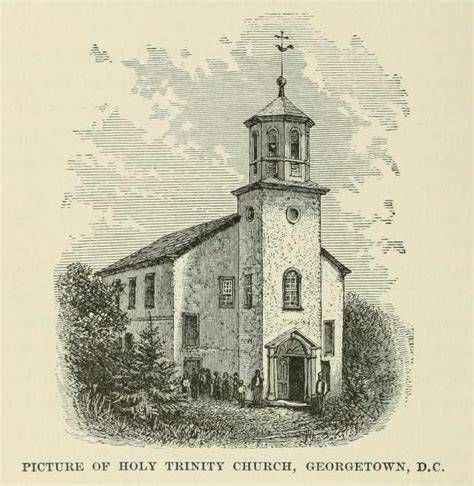
Founding and Early Years
The first building was first known as "Georgetown Chapel." This was because laws against building Catholic churches were not clear at the time. For years after construction finished in 1794, the church was called "Georgetown Chapel," due to uncertainty around the laws against erecting Catholic churches. In addition to Carroll, the church had four lay trustees, Adam King, George King, George Fenwick and James Simpson. This church faced south and included a bell tower.
Today, it is called the Chapel of St. Ignatius. It is used for smaller church events and as an extra space for parish activities.
Growth and the 1851 Church
The church quickly became too small for its growing number of members. So, in 1851, a bigger church was opened at 1301 36th Street NW. This new building faced west and did not have a tower. The first church building was kept and later named the Chapel of St.
Civil War Service
During the Civil War, the U.S. government used the church as a hospital. In 1862, after the Second Battle of Bull Run, it treated over 200 injured soldiers. The government gave the building back to the church in 1863.
Education: Holy Trinity School
Holy Trinity Parish started a school for boys, Holy Trinity School, in 1818. It first used a house near the original church. In 1818, the parish built a schoolhouse at N and 35th Streets NW. Holy Trinity School taught students from first to eighth grade. In 1871, Holy Trinity Church turned its original church building into a school. Classes then moved into that building. In 1918, the parish built two more school buildings. One was called the "Lower School" and the other the "Upper School." Students could not use the Lower School right away. The government needed it for use during World War I.
Parish Life and Jesuit Tradition
Jesuit Father C. Kevin Gillespie, pastor at Holy Trinity Catholic Church in Washington, D.C., celebrates an Oct. 6 Mass as part of the parish's 225th anniversary celebration. Two hundred and twenty-five years since the construction of Georgetown Chapel -- the original chapel built on the lot which is now named the Chapel of St. Ignatius -- the parish community at Holy Trinity gathered at their church for a celebratory Mass on Oct. 6 in thanksgiving for the church’s history and legacy in the Georgetown neighborhood and its Jesuit tradition. “This church, for 225 years, has been a place of so much for so many,” Father Gillespie said in his homily at the Mass.
Anniversary celebrations have been ongoing throughout the past several months, including a lecture series, an anniversary benefit and ending with a Founder’s Day Festival celebration. The Founder’s Day festival included programs displaying the different ministries and interests of members of the Holy Trinity community, historical presentations and discussions, and activities for children.
Art, Faith, and Community Voices
Pictured is an icon of the Holy Trinity, which was written by the Holy Trinity Iconographer's Guild. During the anniversary Mass, a new Holy Trinity icon created by the parish's iconography guild was displayed beside the altar, and the liturgy featured the premiere of the hymn, “Come and Be Fed, Come and Be Filled,” written for the occasion by Mary Louise Bringle with music by Tony Alonso.
Alicia Weber, a member of Holy Trinity Parish since 1971, is a retired historian who worked to put together an art and faith exhibit for the celebration. She spent months cataloging the Ars Sacra (religious art) of the parish. The exhibit included historical vestments and worship artifacts such as an ornate monstrance and chalice. “Hopefully it will allow parishioners to learn more and to see more,” Weber said, noting how many don’t have the opportunity to often look upon religious articles so closely.
Weber has served the Holy Trinity parish community in several different capacities during her time at Holy Trinity, including teaching catechism since 2001. Her favorite part of the parish is a “sense of community,” she said, adding that the music ministry is very impactful. “It just takes all my cares away,” Weber said.
Another longtime member of the parish, Mary Stump, who has been a member since 1966 when she was a graduate student at the neighboring Georgetown University, said she first came to Holy Trinity at the recommendation of a colleague. “Someone suggested that I come, and I never looked back,” she said. “We’ve also been blessed with wonderful homilists, getting to learn from them,” she said.
Linda Arnold, who was married in the parish and raised her children in the parish community, worked in the 1980s to help grow the parish’s adult faith educational programs, which grew from the parents of children involved in CCD (Confraternity of Christian Doctrine) programs. “The only thing I changed was the idea of a year-long program with a theme and then (it) was treated from the point of view of spirituality from Scripture,” she said. “People were just hungry.” “They were willing to work with us...to be co-laborers in the vineyard,” Arnold said.
Notable Worshippers
Many important people have attended Holy Trinity Church. President John F. Kennedy, who was Catholic, and his family often worshiped there. A special plaque in front of the church remembers his visits. President Joe Biden also worshiped at Holy Trinity when he was Vice-President and later as President.
Parish Today
Today, that lot is home to Holy Trinity Parish and Holy Trinity School in Washington, D.C., where 5,937 registered households take part in the parish life. “Like mustard seeds...those five shillings offered those parishioners the faith,” Jesuit Father C. Kevin Gillespie, pastor at Holy Trinity parish, said. Father Gillespie, in the closing of the celebratory Mass, expressed gratitude for the parish community and the work that they invest into Holy Trinity. “This community of faith really inspires faith, hope and love,” he said.
Burial Grounds and Cemeteries
The area where the 1851 church and the Lower School now stand was once a cemetery. This burial ground was there even before Holy Trinity Church bought the land. In 1796, the church bought more land to the west. By 1798, it owned all the land up to 36th Street. Many graves were moved in 1817 when this cemetery closed. However, hundreds of graves still remained as late as 1917.
In 1998, Holy Trinity Church started building an addition. Workers found a skull and some small bones. A special investigation found the remains of 44 people, including men, women, and children. Some were buried as early as 1837, and others around 1865. At least one person was African American.
In 1818, Holy Trinity Church started a new burial ground. It was on the north side of P Street NW, next to what is now Georgetown University's Maguire Hall. This cemetery was known as Trinity Burial Ground or Old Burying Ground. But most people called it College Ground. The first burial happened there in December 1818. One famous person buried at College Ground was Susan Decatur. She was the wife of United States Navy hero Stephen Decatur. In 1837, Susan Decatur gave $7,000 to Georgetown University. This large gift helped save the university from closing due to money problems.
By 1833, over a thousand people were buried at College Ground, according to church records. Burials stopped there around that time. The cemetery became neglected, and many gravestones were damaged or moved. By the 1930s, people thought the land was empty. In 1931, Georgetown University started building a new dorm, Copley Hall. Workers found College Ground again when clearing a "vacant lot" nearby.
College Ground closed because Holy Trinity Church got a new, larger cemetery in 1832. This was Holy Rood Cemetery. It was first called the Upper Grave Yard. It was made bigger in 1853, and a sexton's house was built at the entrance. The grounds were expanded again in 1866 and 1867 to their current size of about 6 acres. A new sexton's house, a receiving vault, and a stone wall with a new main gate were added. Since 1942, Georgetown University has owned Holy Rood Cemetery. The university stopped new burials in 1984, except for special requests. There are 7,312 known burials there, plus many unknown graves for people who could not afford a burial.
In 1953, Georgetown University began preparing College Ground for new buildings. The university said only 189 sets of remains were there. Fifty were moved to Mount Olivet Cemetery. Most of the others went to Holy Trinity Church's Holy Rood Cemetery. In 2018, Holy Trinity and Georgetown University announced a plan to restore Holy Rood Cemetery. This plan includes fixing things, improving the landscaping, and making the entrance better.
Key Dates and Places
- 1787: Holy Trinity Parish started; lot purchased for five shillings.
- 1794: First church building finished and called "Georgetown Chapel."
- 1818: Parish starts Holy Trinity School; Trinity Burial Ground (College Ground) begins.
- 1851: Larger church opens at 1301 36th Street NW.
- 1862-1863: Church used as a hospital after the Second Battle of Bull Run.
- 1918: Lower and Upper School buildings constructed.
- 1998: Remains discovered during construction on parish grounds.
- 2018: Restoration plan announced for Holy Rood Cemetery.
Source: Library of Congress Prints and Photographs Division Washington, D.C. Source: Library of Congress Prints and Photographs Division Washington, D.C. Source: Library of Congress Prints and Photographs Division Washington, D.C.
tags: #santisima #trinidad #iglesis #washington